
How to Invest in Your Health to Protect Retirement Savings with Jenny Smith
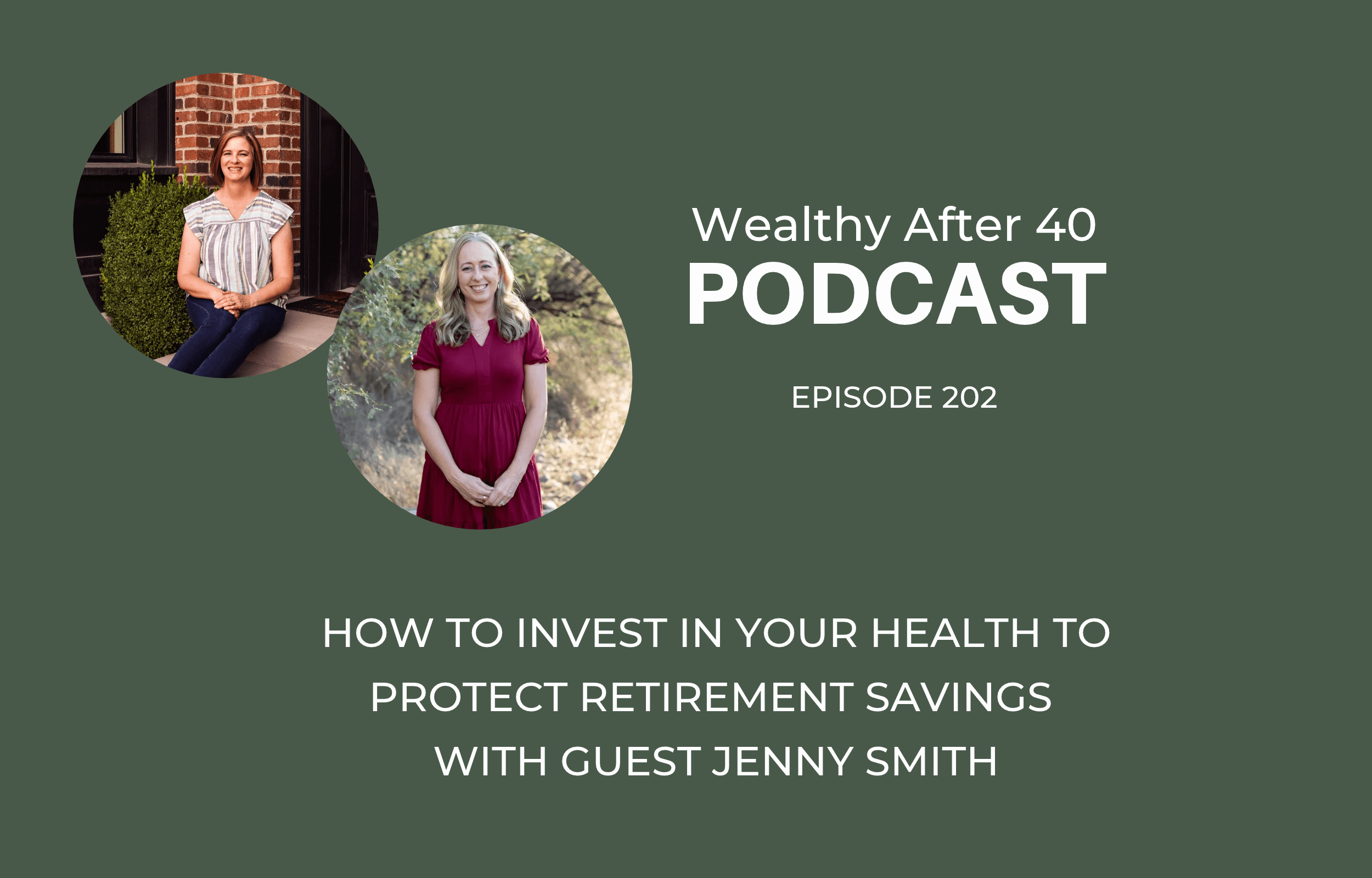
Listen to the Wealthy After 40 Podcast on: Apple Podcasts | Spotify | Your Player of Choice
Click HERE for an Unedited Transcription of the Podcast Episode
Welcome to the Wealthy After 40 podcast. I'm excited to introduce you to our guest today. This is Jenny Smith. She is a board-certified health and wellness coach passionate about helping women over 40 find calm in the chaos of perimenopause. She spec- specializes in simple evidence-based lifestyle strategies to help women reduce anxiety, improve mood, and feel more like themselves during this often confusing season of life. Through her coaching, podcast, and educational content, Jenny empowers women to take control of their health with practical tools that fit into their everyday lives. Jenny lives in Arizona with her husband, their two kids, and two adorable fur babies who make sure she gets her daily walks in. When she's not coaching, you'll likely find her talking on the phone with a good friend, hiking the desert trails, or wandering through a local farmers market with a coffee in hand. Yeah. Welcome to the podcast, Jenny. So glad to have you here. Thank you so much, Dalene. I'm excited to be here. Yeah. I'm excited to dive into this. And I just wanna say if there are any men listening, you'll totally get something out of this podcast as well, especially and also if your wife is dealing with this. Hopefully you'll get a little more understanding. But we are gonna be talking about the health and wealth connections, and I'm so excited to have Jenny share her thoughts around these areas that we're gonna discuss. So the first one is, Jenny, you say your health is your greatest asset. Yeah. And I know assets are like homes and, not really a car- but our retirement savings, we think about that, but your health Everybody's individual health, yeah. Share with us your thoughts on that. Yeah right out of high school, going to college, getting a good job, finding this job, working, so many years saving for retirement to hopefully enjoy that retirement. But oftentimes we're not focused or emphasizing on how we're caring for ourselves to be able to enjoy and take that time to really enjoy retirement and do the things that we love to do. So thinking about gosh, if I can retire, I wanna travel, and I wanna spend some time with my grandkids, or I wanna take care of my grandkids and be a big part of their lives and running around with them, kicking the ball. But so many times if we don't take care of ourselves, we may not be in a position to do those things. So without our health, nothing else really matters. Yeah, it's so true. When I met my husband and, God bless that I was very young when I met him, but, into our 30s and I was evaluating the differences between my parents and his parents. And now my parents were 12 to 15 years older, but honestly health and the way they got around, moved around, was so much younger. And so yeah, it's so important to take care of our health. Moving into chronic disease. The cost of chronic disease or the cost of health problems and why prevention is important. I think it was on Threads today, and somebody's like, "I saw people will invest in nothing but, everything but their health." And it was so interesting that I was like, "Oh, we're jumping on with Jenny," and it's like recognizing The connection of some of these things, like what is the cost of disease or chronic disease, and why is prevention so important? Yeah, so I think just in our human design and personality and how we are, many of us are reactive versus proactive. So we tend to address things when something happens. So let's say we get a diagnosis, and it's like, "Oh I better start taking care of myself now," when actually the symptoms that come up for us happened years and years before. So it's just, snowballs into this until it gets to a point where you can't ignore it anymore. So I don't know the stats on how much Americans spend on medical care. It's a lot of money, and yet we tend to be the most sick. It's like we spend- ... all this money towards medical care. I think it's one in 10 have diabetes, and then five out of 10 have two chronic diseases associated with it. So if we don't get a, a handle on our health and start addressing it, then it leads to more health problems down the line. I work with a lot of people who are taking care of loved ones who are sick, who can't get around, who are really struggling financially to be able to pay for their medications. There is a popular medication out there that is almost everyone I talk to who has cholesterol issues takes it, and it's very expensive. And it's a matter of the money that we work so hard for all of these years, we're putting it towards the cost of care to go to the doctors, to go to the specialists, to get the treatments, to pay for the medications. And then if you get to a point where you are not able to do a lot of things independently, then it's hiring caregivers, and then do we transition into assistant living, skilled nursing facility? All of those are incredibly expensive, and the cost can just be astronomical. We should certainly prepare for that time of our lives because we never know what could happen to us, where we end up in a situation where we need some more support and more in-home care or maybe out of the home care. But we should also certainly take the money and invest in our health now, whether it's going to the gym, eating healthier foods. I hear oftentimes, like healthy foods are so much more expensive than the, other stuff." And I was like it's not because when you eat some of that other stuff, you tend to be hungrier, and then you want more of that food, and, it's designed to entice us and crave us to want more of that food." So you can certainly do healthier food on a budget, investing in your health in that sense is taking care of your body and not putting it off. I'll do that someday," or, "I'll join the gym when I have more free time," or, "I'll go for a walk." And, oftentimes it's five, 10 minutes, whatever you have in your day to make time for you Adds up. Makes a huge difference. Yeah. There's two things that I hear I'm gonna travel in retirement," or, "I can, really take care of my body in retirement 'cause I'll have the time." And I know when you're working it is so hard, but recognizing what you can do and, getting some of those things in place before. I know everybody is okay, what can you do to start getting ready for retirement? Jenny, what are a couple things people can do right now that are most impact... And I know this is generalizing, and it could be very different, but I'm sure there's two or three things you could say, "If you can do X, Y, and Z, you're going to at least set up, set yourself up even better." What would you say those are? As far as lifestyle habits? Yeah. Okay. Sleep is number one. Sleep is number one. Prioritize it. Don't put it off. Do what you can to get good quality sleep. Just, not getting in the habit of, let's say, staying up for hours watching Netflix, and then you realize, "Oh my gosh, I need to go to sleep. I have to get up for work tomorrow." Really taking the time to set your sleep up for success, and that could look like cutting off food at least two hours before bed. Because when you eat close to bed I hear all the time, especially with so many of my clients, is they get home late, they're rushing, and they're eating really quickly, and then they go to bed. So it's doing your best to try to eat at least two hours before bed, because when you eat so close to bedtime, your body spends time digesting food, and you don't get that rest and repair Your body's not getting that rest and repair that it needs because it's busy digesting the food. So our bodies are uniquely designed to care for us, but we have to give it the environment for it to operate in a way that's gonna take care of us. Our body is our, it's everything. If we don't- have a healthy body, then it's like I said if our health is out of whack and not great, then so many other things are just not as important. And we don't know that until it's so bad. Yes everybody touts sleep. What is something else that they could maybe focus on? Yeah. So if they're dialed in on sleep or that's not where that they wanna start, I would say start with nutrition and how you're fueling your body. I think that's super important. I talk about protein all the time with my clients. Protein is so important to help regulate our blood sugar, keep us satiated, help us sustain our muscle that we have. Specifically women after age 35 we start to lose muscle mass, and we have to work harder to maintain it and to build it. And so having the protein and eating enough protein is super important for that. And really getting good quality protein, making sure that you have enough of it on your plate. I worked with a client, she's like, I had two hard-boiled eggs and a sausage," and I thought that's-" 20 grams. We need more. People don't realize how much we need. So we at least need about 30 grams of protein, which would be, like, the size of your palm a size of a deck of cards, making sure that is a focal point on your plate. Also fiber, getting enough fruits and vegetables. That will give you the energy that you need to be able to check off the things on your to-do list. We have so many things to do, and then we come home from work, and we're like, "Oh, I'm just so tired, and then I have to make dinner, or I have to eat dinner." And that's why I think having meals prepped, taking some time over the weekend to prep your food so that you do come home and you have healthy meals ready to go. Just, put it on a plate. I always have a protein source prepped starch- non-starchy vegetables, a healthy fat, even starchy vegetables. I put it all on a plate and I heat it up when, on those nights where I don't have a lot of time. So there's ways to get nutritious meals in. You just have to take some time- ... to prepare for those. But when you aren't, when you are sleeping well and you're rested, and when you are fueling your body with what it needs, you have energy. You have energy to do things. And it's only gonna lead to better health. Yeah, I love that. So you touched on meal prepping. So before we dive into that, I want to share what I did when I was working. I still do it now because, thinking of meals is so difficult for me. I literally pick three meals a week. We have leftovers three more days, and then the one day off, we do either pizza, we do eat out once, or we do pancakes sometimes. Yeah. And we just do that on our weekend. It's very easy for us. And that's been successful for me, and I think that's really finding out what you need to do. So let's talk about meal prepping, meal planning, like some tips and tricks, and maybe somebody can find something here, 'cause I know, working, getting home at 5:00 or 6:00, you literally don't wanna cook. What are some ideas you have? Yeah. I like how you said pancakes, because we have brinner occasionally too. Yeah. Love it. Breakfast for dinner. Love it. So Looking for a day of the week that you can spend one or two days a week so you're not in the kitchen for hours. I like to look at different recipes that I've been wanting to try. I like how you said, "I only choose three meals and that gets us through the week." I think that's really helpful. It's harder when you have a bigger family. It's harder when you have younger kids, 'cause they don't wanna eat a lot of what we want to eat. However, if you take the time to plan it and have, the meals written down, then go to the store, you gather all the ingredients. And what I tend to do is I will prep my protein sources and chop up my veggies and either cook and bake them first so that I have them, and then that way I do Mason jar salads all the time 'cause that will keep them fresh for a really long time. And then I just kinda throw that in a bowl, top it with some protein, and then I have a balanced meal. You can cook potatoes ahead of time too so you don't have to spend time cooking that. You can cook rice. Getting an Instant Pot, I think that's what, like a pressure cooker. So quick and easy. So many meals, and I use the computer all the time where I'll go, "Give me an Instant Pot recipe for lasagna," and they'll come up with 10, choices to choose from. Usually the top one's the best one. And go from there. Having tools in the kitchen, an air fryer so you don't have to turn your oven on. That usually cooks things really quickly. I always buy frozen vegetables and I just pop them in the microwave, it's quick and easy to have the vegetable side. Also, if you don't like meal prepping, if you're just like, "The kitchen is not my place, I don't like it," if you have the extra funds, and you have the money, and I don't know how this goes with some of the things that you talk about with retirement planning, but it's helpful to hire out and have somebody do that for you. There's a lot of companies that will meal prep now healthier foods. They also accommodate- diet restrictions, anything that you might need to stay away from, whether it's dairy or gluten or anything like that. You could find lots of companies that will do the meal prepping for you and save you time. Yeah. That is so smart. Yeah. Usually my perspective on, quote, "spending money," it's not about if I can do it. It's where do you wanna spend your money wisely? It's like recognizing where you really value spending your money, 'cause you may not wanna spend time there, it doesn't work out. I think that's very important. But then knowing- ... okay, it means I'm gonna work harder on the other side where I can save money. I think the trade-offs- which is a, a conversation I had today with a client, are so important. And so- ... investing in your health, if that means hiring somebody to- cook for you or bake for you. Cook in bulk, buy in bulk. That's also another thing. Thank you. I failed to mention that. Doubling recipes, freezing some for another time. Soups freeze really well. Just, double, tripling recipes and saving it for later. There are ways- to get the help. You can hire local college kids that are maybe in chef academy or something that need a part-time job that's they come in once a week, and they help you chop vegetables or put your meals together so all you have to do is throw it in the oven. There's, where there's a will, there's a way. It is. It is. Some people just don't love to cook, and maybe they need to be shown different ways- or how to make it easier." I know over the years I've learned "Oh, my gosh, this is a much easier to way to do what I've been doing," and so really educating yourself, maybe taking a chef's class of some sort- just to learn so that you can do it really super easy. Okay. So another thing to talk about, especially with most people who are working nine-to-fives, whether that's exactly the hours or not working corporate missing work due to doctor's appointments costs time and money. It's those follow-ups that always get you, right? You go in for the one thing, and then they're like, "Okay I need you to go this test and then follow up here and then this and this." Can you talk more about that? It's, yeah, it's missing work. It's not wanting to get behind or, feeling like you're not doing your job because you have these health problems. It's, just goes along the lines of what are we doing this for? And it's, if we're- we're working nine to five, and so many of us, and I, so many of us are in a job that we don't like. And that certainly impact our health and how we're feeling. And making sure that, if you're having to miss work and, you're ending up on disability and things like that that's, that is so much time away from the things that you want to be doing. And I think it's important to look at your job and- this is something that I think is so hard for so many people because they're like I've been in this job for so many years, and I can't leave because I have to work up until this date because this is when I'm gonna retire and get my pension." Really comparing it and looking at the pros and cons 'cause if it's really taking a toll on your health- Then is that job worth it to continue staying, and what can you do in addition? And sometimes maybe it's even talking to your boss. I have a client right now who loves her job, but it has gotten so overwhelming because people quit, and they're like- Yeah She'll do it. She'll take on this." "She's been getting it done." And so oftentimes if you're doing it and you're getting it done, they think, "Oh, she can do this or he can do this. We'll just keep giving him this." Yeah. So have communicating with your work, communicating with your employer, letting them know "I am overwhelmed, my health is taking a toll, I'm missing work because of stress." They say that the number one reason for emergency room visits is stress related issues. Yeah. I believe it. Yeah. And I know that people who are listening to this podcast can certainly relate to that. So if you feel like you're in a position where you can't really talk to your employer, you must prioritize ways to reduce stress in your life, whether that's taking a break from your desk and going for a short walk, whether that's plugging into a meditation at night. Whether it's taking five deep breaths when you're in a dreaded Zoom meeting and you're bored to tears. Yes. Oh my gosh, just take a deep breath. Just take a deep breath. Inhale peace, exhale stress and worry. Just there's so many things. Getting outside in the sunshine is so healing and it's proven to help us ground and reduce stress in our body. So anything that we can implement that doesn't take a lot of time, that doesn't, require a job change can really help calm your mind and body and so that you're not so stressed out that you burn out and you end up in the emergency room. Yeah. Stress is huge. And sometimes stress is very quiet. I think the one, the ones we're aware of, if we can control those, the other ones can benefit as well. I know a lot of my listeners and even yours as well, you're looking at caring for your aging parents, or you will be if you have not already. I was caring. I was keeping everything in sync and working with all my siblings. We were doing it. But the stress really damaged my health, and I'm somebody who really takes care of myself. Yeah. And so it's like recognizing stress can come in so many ways. But to be prepared for those areas that you can't control 'cause i'm not gonna turn my parents over to somebody else just- to keep my stress under check, right? So it's really taking care of all of those other things. Important. Yeah. And also, you mentioned something important. There are so many people who are caring for their aging parents, and it is extremely stressful. It's really hard to see your parents like that and to have to manage appointments and manage their affairs. Even if you're not caring for aging parents and you are so overwhelmed at work or you have a lot on your plate, who can you ask and who can you go to for help? That's why it's if you come home and you're, let's say you're working 9:00 to 5:00, then you have to go take your kid to their soccer game, or the weekends you have plans for, like you're taking care of parents and you're- ... I just don't have time to prep for myself. That's when you would ask for help and find out what are ways for somebody to come in and help you so that you can free up some of your time so you can do some things for you. I think it's so important to make time for the things that bring us joy and fill our cup and make us feel good. Yeah, it is so true. I currently have a girlfriend going through a situation and I'm like, "You've got to remember to ask for help," and it's even if you can get an hour reprieve somewhere, right? Hopefully every day, but if not every day, as many days as you can. It is so helpful. Jenny, this has been such a good discussion. Do you have any last words or, anything you can share with our listeners? As we were talking about asking for help, I think it's very common for women in general to be the caretakers. And in our modern society, we are doing all of it. We're working, we're managing the home, we're managing appointments, we're managing the appointments for our loved ones, we're taking care of kids. We have so much on our plate, and we think we can do it all 'cause, 'cause doing it." It's like we compare ourselves. Doing it. I should be able to do it." I can't say that I can't do it or there's something wrong with me, and absolutely not. We all have our own capacity. Yeah. We all have our threshold of when we get to a point where we're we are gonna boil over or burn out. So it's just a matter of stepping back, all of us, men, women, all of us, step back- what is my point? What is my line in the sand? When I cross over that, when is it time for me to reach out and ask for help? I think that's so important to be okay with that, and to know that, we're not intended to do all these things and juggle all these things, and then still, get by and be- Yeah ... hunky-dory. Yeah. Oh my gosh, that is, so true and such good advice. As you were talking about that, I'm like, "You know what? Maybe there is something to being minimalist, but applying it to every area of your life," right? What is the minimal amount that brings me joy, makes me happy, fills the responsibilities I need to fill, because we know we all have that. And that we can actually just step back and slow down and, take care of ourselves. So that's huge. All right, Jenny, I know you have a podcast as well, and then I know you also have a protein guide, so share with our listeners both of those before we close. Yeah. I just started my podcast in March. It's You're Not Crazy, It's Perimenopause. And it's specifically for women over 40 who are dealing with perimenopause, and recognizing some of the signs and symptoms that we aren't familiar with, and how to navigate that. I talk about all kinds of things as it relates to caring for our bodies in this season of life, and what we can do to care for ourselves. And I also talk about a lot of the educational components of it too. I also have guests, and you're gonna be on there soon too. I'm really thankful. So I'm excited to have you. Yeah. And my protein guide is a guide that I created because it is so important that we eat protein, get enough protein in to sustain muscle, to build muscle, to keep steady moods, and to, to make sure that we have energy and we're satiated and we're feeling good and strong. It helps in so many ways. And so I created a guide on how much should we be consuming, what does it actually look like, and several recipes and options for breakfast, lunch, and dinner. So it's a pretty comprehensive guide. I've gotten a lot of great feedback on it. So if you want to download that I encourage you to do so. Yeah. Thanks for letting me share that. Thank you. And both of those links and a few others, will be down in the show notes, so go connect with Jenny. Go give her podcast a listen. And I love your title, You're Not Crazy, It's Perimenopause, because, it's truly just what's happening to us. I'm grateful that you have that out there. So listeners- ... go connect with her. And I'm so glad you could be here today, Jenny, and we'll talk to you guys next week. /p>
When you think about preparing for retirement, what comes to mind?
Saving enough. Paying off debt. Creating a retirement budget. Figuring out when you can stop working.
But there’s another retirement asset that often gets overlooked: your health.
You can spend decades building your retirement savings, only to find that poor health, chronic disease, medications, caregiving, or rising health care costs take a much bigger bite out of your money than you expected.
That’s why investing in your health today isn’t just about feeling better right now. It can also be part of protecting your retirement savings and creating a retirement you’re actually healthy enough to enjoy.
I recently had a conversation about this with Jenny Smith, a board-certified health and wellness coach who helps women over 40 navigate perimenopause with practical, evidence-based lifestyle strategies. While our areas of expertise are different, we discovered an important connection between health and wealth: the choices you make today can affect both your future health and your future finances.
Your Health Is One of Your Greatest Retirement Assets
Most of us spend our working years preparing financially for retirement.
We go to work, earn money, contribute to retirement accounts, pay down debt, and try to make smart financial decisions so that someday we can enjoy more freedom. But what happens if you reach that retirement date and your health prevents you from doing the things you dreamed about?
Maybe you imagined traveling. Maybe you want to spend more time with your grandchildren. Maybe you want to hike, garden, volunteer, play golf, or simply have the energy to enjoy your days without constantly managing health problems.
As Jenny pointed out, without our health, many of those financial goals don't matter nearly as much. Your retirement savings are an asset. Your home is an asset. But your health is an asset, too. And just like your financial assets, it deserves attention and investment.
Don't Wait Until Retirement to Take Care of Your Health
One of the biggest traps we can fall into is thinking we'll have more time later.
“I'll exercise when I retire.” “I'll eat better when work slows down.” “I'll finally take care of myself when I have more time.”
But retirement doesn't automatically give you better health.
In fact, some health problems develop slowly over many years. By the time you receive a diagnosis, the underlying issues may have been developing for quite some time. That's why prevention and healthy habits matter.
You don't have to completely transform your lifestyle overnight. Small, consistent choices can create a healthier environment for your body and give you a better foundation for the years ahead.
And importantly, taking care of yourself doesn't have to mean spending a fortune.
There are many ways to invest in your health that require more intention than money.
Two Health Habits to Prioritize And Protect Your Health
During our conversation, Jenny highlighted two areas that can have a meaningful impact on your health: sleep and nutrition.
1. Prioritize Quality Sleep
Sleep can be easy to sacrifice when you're working, raising a family, managing a household, or caring for aging parents. But consistently getting enough quality sleep is an important part of taking care of your body.
One practical place to start is creating a bedtime routine that allows your body to actually rest and recover. For example, Jenny recommends being mindful of eating too close to bedtime. When your body is busy digesting a meal, it may interfere with the rest and repair your body needs during sleep.
You don't need a perfect nighttime routine. Instead, look for one small change you can make consistently. Maybe that means going to bed 30 minutes earlier. Maybe it means putting your phone away. Maybe it means creating a more consistent bedtime.
The goal isn't perfection. It's creating habits that support your body instead of constantly asking it to run on empty.
2. Pay Attention to How You Fuel Your Body
Nutrition is another important piece of protecting your health as you get older.
Jenny especially emphasized the importance of protein for women over 40. Protein can help with satiety, energy, blood sugar regulation, and maintaining muscle.
And maintaining muscle becomes increasingly important as we age.
Instead of overcomplicating your meals, start by making protein a focal point of your plate. Add fruits and vegetables, fiber, healthy fats, and carbohydrates that work for you.
The goal isn't to create a complicated diet. It's to fuel your body well enough that you have the energy to live your life. Grab her protein guide HERE for more support in getting enough protein.
Make Healthy Eating Easier, Not Perfect
One of the biggest obstacles to eating well isn't necessarily knowing what to eat. It's having the energy and time to prepare it.
If you're working all day and coming home exhausted, the last thing you may want to do is spend an hour preparing dinner. That's where meal planning and preparation can help.
You don't need to prepare seven completely different meals every week. In fact, one of the strategies I shared during our conversation is to keep things incredibly simple: choose three meals, make enough for leftovers, and give yourself one night where you don't have to follow the plan.
Jenny also recommended preparing ingredients in advance rather than necessarily preparing complete meals.
You might:
Cook several protein sources at once.
Chop vegetables ahead of time.
Prepare rice or potatoes in bulk.
Keep frozen vegetables available for quick meals.
Double recipes and freeze portions for later.
Use tools like an air fryer or pressure cooker to save time.
And if cooking is something you genuinely don't enjoy, there is another option: spend money where it adds value to your life. Maybe hiring someone to help with meal preparation is worth the cost for you. That's not automatically “bad spending.” It's about making an intentional decision about where your money and time are most valuable.
If you spend more on prepared healthy meals, perhaps you find another area where you can spend less. That's a financial trade-off and intentional spending is at the heart of good money management.
Don't Underestimate the Cost of Stress
Health isn't just about what you eat or how much you exercise. Stress matters, too. And for many people over 40, stress is everywhere.
Work.
Family.
Children.
Aging parents.
Finances.
Caregiving.
Household responsibilities.
Sometimes stress is obvious. Other times it's so constant that you don't even recognize how much it's affecting you.
During our conversation, we talked about the importance of finding small ways to interrupt that stress.
Take a short walk.
Step away from your desk.
Spend a few minutes outside.
Take several deep breaths.
Practice meditation.
Ask someone for help.
These things may sound small, but small actions can add up.
And if your job is consistently taking a toll on your health, it's worth asking yourself a difficult question:
Is staying exactly where I am really worth the cost?
Sometimes the answer will be yes. Sometimes you may need to have a conversation with your employer about workload or boundaries. And sometimes you may need to consider a bigger change.
The point isn't that everyone should quit their job. The point is that your health deserves to be part of the decision.
Your Retirement Plan Needs a Health Conversation
When we talk about retirement planning, we often focus on the financial side.
How much have you saved?
How much will you spend?
When can you retire?
What will your income look like?
But there's another question worth asking:
What kind of health do I want to have when I retire?
Because your retirement vision isn't just a number. It's a life. And if your vision includes traveling, spending time with family, being active, or simply having the freedom to enjoy your days, your health is part of that plan.
Of course, none of us can control everything that happens to our health. That's why preparing financially for future health care needs is still important. But preparation doesn't have to mean assuming the worst.
You can prepare financially and invest in your health today. Those aren't competing strategies. They're two parts of the same retirement plan.
Your Health and Wealth Are More Connected Than You Think
The goal isn't to become obsessed with your health or spend your entire life trying to prevent every possible problem.
It's about recognizing that the decisions you make today can influence the options available to you later.
Your retirement savings are there to give you choices. Your health can help you actually use those choices.
So instead of thinking, “I'll take care of my health when I retire,” consider flipping the script:
Invest in your health now so you can protect your retirement savings and have the health and energy to enjoy them.
You don't have to overhaul your life. Start with sleep. Look at how you're fueling your body. Find ways to reduce stress. Ask for help when you need it. And then keep taking the next small step.
Because retirement isn't just about having enough money to stop working.
It's about creating a future you are healthy enough, financially prepared enough, and confident enough to enjoy.
Connect with Jenny Smith
Connect with Guest Jenny Smith
Download her Protein Guide
More about Wealthy After 40 with Dalene Higgins

Wealthy After 40 is the retirement planning and budgeting podcast for Gen X women and couples who are tired of wondering if they're doing enough for retirement and ready to know exactly what to do next. It's for people who are earning, saving, and trying to make smart money decisions, but still don't have a clear picture of whether the retirement they want is actually possible.
Hosted by Dalene Higgins, Retirement Strategist and Money Coach, this show gives you a simpler way to think about retirement. Instead of generic calculators, complicated financial jargon, or being told to simply "save more," we'll look at your real numbers, your real life, and the decisions that can make the biggest difference.
I’ll answer questions like:
How much do I really need to retire?
Am I actually on track for retirement?
How do I catch up if I feel behind?
Is it too late to save for retirement at 50?
Should I pay off debt or save for retirement?
How much should I have saved by 50?
When can I realistically retire?
How much should I be saving for retirement?
How do I create a retirement plan that actually fits my life?
What is the 4% rule, and does it really apply to me?
What should I do if I want to retire sooner?
This podcast is about more than saving for retirement. It's about understanding what’s holding you back and how to make intentional decisions with your money today without putting your entire life on hold for tomorrow.
Wealthy After 40 will help you move from worrying about whether retirement is possible to knowing what you need to do to make it happen, while still enjoying the life you're living right now.
