
Retirement Mistake to Avoid: Why "Getting Organized First" Is Costing You
Do you dream of retiring comfortably, feeling confident about your future, and knowing your money is working for you, but find yourself thinking, "I need to get my finances organized first"?
If so, you may be making one of the biggest mistakes that slows down retirement progress.
Maybe this sounds familiar:
"I'll reach out for help after I pay off some debt."
"Once my savings are more consistent, then I'll get support."
"I just need to get everything organized before anyone looks at my finances."
Many women and couples over 40 find themselves in this exact situation.
It's easy to understand why. There is often a fear of judgment or embarrassment around money. Maybe you feel like you should have things figured out by now. Maybe you're worried someone will point out mistakes you've made in the past.
So instead of getting help, you focus on solving one piece of the puzzle first.
The problem is that trying to fix one financial challenge before getting support often delays the very progress you're hoping to make.
The truth is that money coaching isn't something you do after your finances are organized. It's often the thing that helps you get organized in the first place.
In this blog post, I'll show you why waiting can actually slow down your retirement progress, what to focus on instead, and how taking a complete view of your finances can help you build momentum faster.

Why Waiting Is Slowing Your Retirement Progress
Many people believe they need to solve their biggest money problem before seeking help. Unfortunately, that approach not only creates delays but has you missing opportunities along the way.
You May Be Solving the Wrong Problem
One of the biggest reasons people get stuck is because they're focusing on the symptom instead of the cause.
When my client Beth came to me for support, she said, “My spending is not good and I’m creating too much debt.” She believed her debt was due to her overspending.
After reviewing her financial system, we discovered something surprising. The issue wasn't overspending. The issue was a lack of planning and preparation for things to come.
Once we adjusted her cash flow system and created a strategy for both savings and debt repayment, she was able to clearly define how much to save and how much to put toward debt each month.
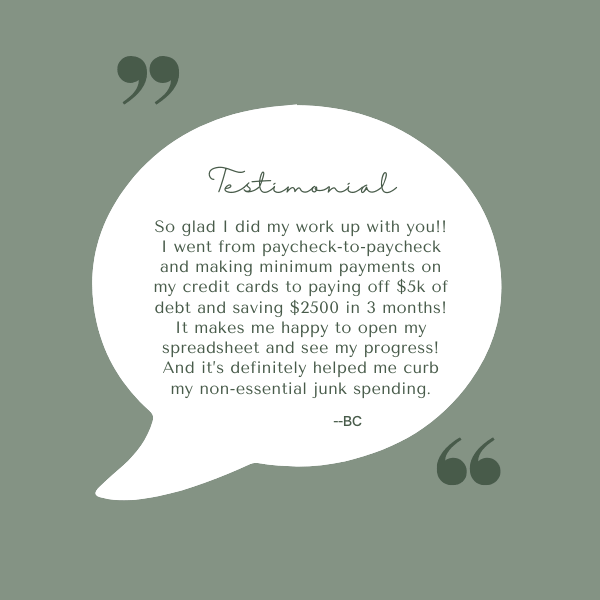
Her progress accelerated because we identified the real problem.
When you're trying to solve money challenges on your own, it's easy to focus on the most frustrating issue instead of the issue that's creating the frustration.
Paying Off Debt Without a Future Vision Can Keep You Stuck
Debt is often the most visible financial problem, so naturally, many people focus all their energy there.
But if you're aggressively paying down debt while ignoring emergency funds, sinking funds, irregular expenses, and retirement savings, you may find yourself right back where you started — only now with less time to build the future you actually want.
Here's what often happens:
You make great progress in paying off debt.
Then the car registration comes due.
A home repair pops up.
Christmas arrives.
A summer vacation needs funding.
Insurance premiums increase.
Without money set aside for these expenses, many people end up reaching for the credit cards again. The debt balance goes down, then back up. Then down again. Then back up. It's exhausting and discouraging.
And here's what makes it even harder to see: while that cycle is spinning, retirement savings often get pushed to "later." The thinking goes, I'll start investing once the debt is gone. But later keeps getting delayed, and every year that passes is a year of compound growth you can't get back.
What looks like a debt problem is often a cash flow problem, combined with an absence of a forward-looking plan.
Without a system that accounts for debt repayment, future expenses, and retirement contributions happening at the same time, progress can feel frustratingly slow. And the retirement finish line quietly moves further away with every cycle.
You're Missing the True Cost of Your Reality
One reason traditional budgeting often falls short is that most people only look at money in short periods. Either every two weeks when paychecks arrive, or monthly, thinking through all the bills we pay. While these two main items happen monthly, life doesn't operate on a monthly schedule.
Car maintenance doesn't happen monthly. Christmas doesn't happen monthly. Home repairs don't happen monthly. Vacations don't happen monthly. I could go on and on, yet these expenses are very real parts of your life.
When you only focus on the current month, you miss the true cost of your life and that number matters more than most people realize. It's the foundation of an accurate retirement target, the real figure behind your financial independence number. (link to podcast episode or blog post about calculating this number)
When large, irregular, and future expenses aren't part of the picture, retirement planning gets built on an incomplete budget. You end up planning for a version of your life that's smaller than the one you're actually living.
And that gap has consequences. You might arrive at retirement thinking you're ready, only to find the money doesn't stretch as far as you expected or that maintaining your current lifestyle requires tradeoffs you never planned (or wanted) to make.
The good news is that there is a better way.
What To Do Instead
Rather than focusing on one frustrating money problem, start by looking at your entire financial picture. A holistic approach helps you see where your money is flowing, where the gaps exist, and which actions will create the biggest impact.
Step 1: Review Every Bill You're Paying
Start by creating a complete list of your monthly expenses.
Write down:
Every company you pay
Every subscription
Every recurring expense
The amount of each payment
Then ask yourself:
"Does this still align with the life I want?"
Many of us continue paying bills simply because we've always paid them. One of my clients completed this exercise after our first session, canceling three subscriptions, not because she wanted to eliminate those services, but because reviewing them helped her discover better alternatives.
Sometimes awareness alone helps you find opportunities.
Step 2: Identify What's Truly Left Over
After totaling your monthly bills, estimate what you spend on:
Groceries
Fuel
Eating out
Entertainment
Household expenses
Then calculate what's left. This is your available monthly savings amount.
Take a moment and look back over the last few months and ask yourself: has this money actually been saved? Or has it been quietly absorbed by something else?
For many people, the money is technically there every month. The problem is that it never gets directed anywhere intentionally, so irregular expenses (or other expenses) eat it before it has a chance to become anything meaningful.
When you start giving that leftover money a job before it disappears, the shift is significant. You build a cushion for upcoming expenses first, which creates the stability that makes everything else possible. And once that foundation is in place, you can start asking a bigger question: how much of this can be redirected toward retirement savings?
That's where the real momentum builds. Shifting even a portion of that reclaimed money into retirement savings consistently, not someday, is what starts closing the gap between where you are now and the retirement you're actually planning for.
Step 3: Build the System and Start Closing the Gap — At the Same Time
This is where the real momentum begins.
Most people think you need a perfect system in place before you can start making real retirement progress. But waiting until everything is set up just right is what keeps you stuck. The truth is, you build the system and start closing the retirement gap at the same time.
Your financial system gives your money a clear destination every single month. It covers the essentials, monthly bills, everyday spending, emergency funds, sinking funds, and debt repayment, but it's built with one non-negotiable at the center: your retirement goal. Not as an afterthought. Not as whatever is left over at the end of the month. As a priority baked into the plan from day one.
When your system is built this way, everything shifts. You stop reacting to surprise expenses and start expecting them. You stop wondering if you're doing enough and start seeing the evidence that you are. And instead of feeling like retirement is some distant finish line you're hoping to reach someday, you feel the progress because you're making it right now, with every single paycheck.
The system doesn't just organize your money. It accelerates your path to retirement.
What's Next?
If you've been waiting until your money is "in order" before getting help — this is your sign to stop waiting. Getting support is exactly what gets your money in order. And the sooner you start, the faster you get to retirement.
Inside my Retirement Ready Coaching program, we don't ease in. We jump straight into building your system and closing your retirement gap at the same time. From your very first session you'll know your retirement number, have a clear action plan, and be making real moves toward the retirement you actually want.
No more guessing. No more saving in the dark. Just a personalized strategy built around your life and a clear, accelerated path to retirement.
When you have a complete picture of your finances — savings, debt, and expenses working together — everything changes. You'll:
Build savings more effectively
Pay off debt without repeating the cycle
Prepare for irregular expenses without panic
Create stability and confidence with every money decision
Move toward retirement faster than you thought possible
If you're ready to stop wondering if you're on track and start knowing — let's talk.
Book your Retirement Blueprint Call and we'll dig into where you are today, identify what's really standing between you and retirement, and map out the exact steps to start making consistent progress.
Your retirement isn't someday. Let's make it a plan.
