
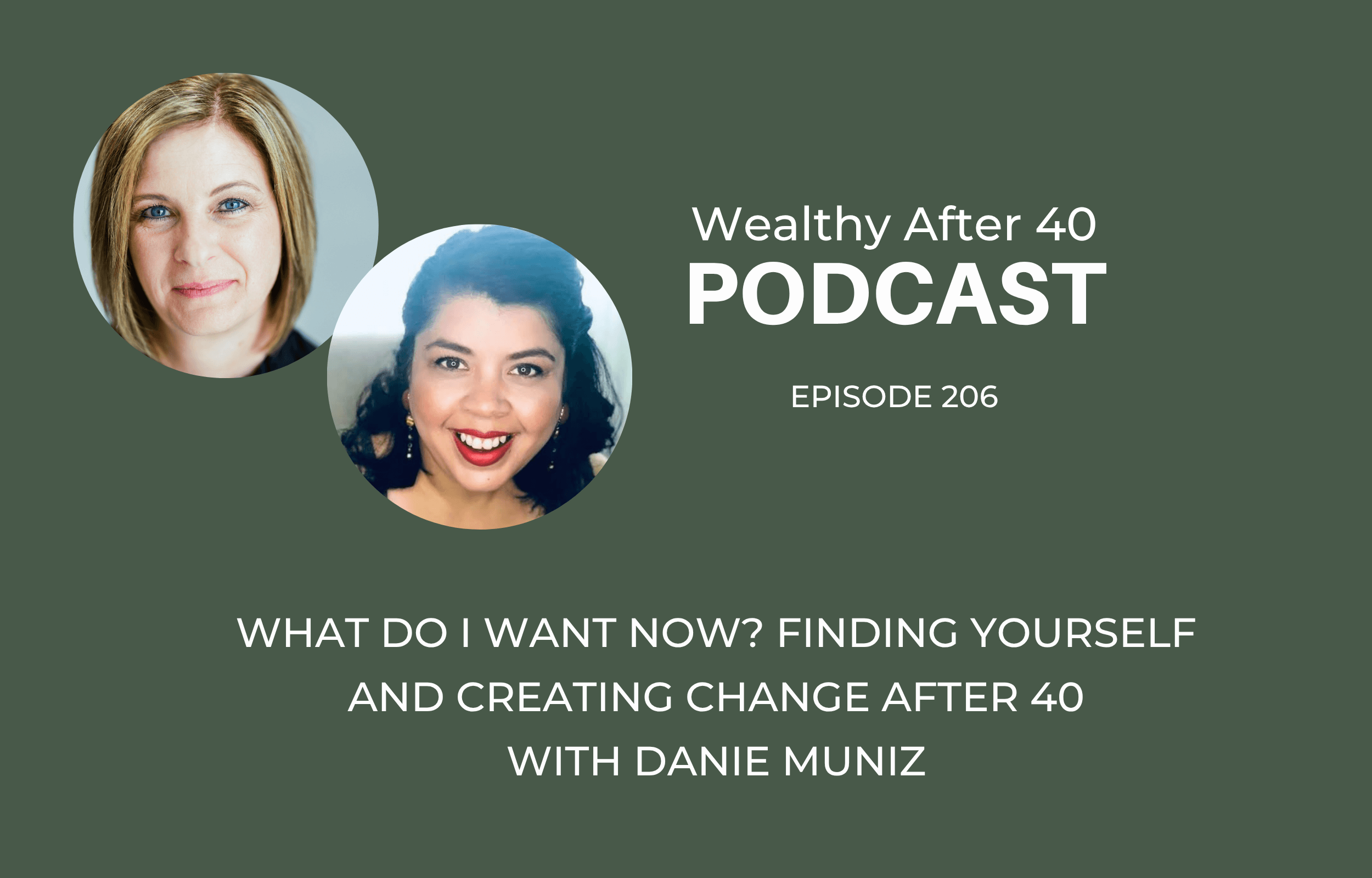
What Do I Want Now? Finding Yourself and Creating Change After 40
Listen to the Wealthy After 40 Podcast on: Apple Podcasts | Spotify | Your Player of Choice
Click HERE for an Unedited Transcription of the Podcast Episode
Welcome to the Wealthy After 40 podcast. I'm ex- so excited to have Dani Muniz with us today. And so Dani, tell us who you are and what you do. First off, thank you, Dalene, for having me on the show. So I am Dani, the founder of Sacred CEO. So I work with women who are in that in-between space where they're growing, they're healing, they're evolving, but things don't feel fully aligned anymore. And instead of giving more strategy, it's usually teaching conscious leadership. So how to lead yourself through those challenging moments maybe where your emotions are getting the best of you, or you're struggled in making a decision, or maybe there's an identity shift that's happening. So I host a community called Sacred CEO Collective, where women come together to do this work in a really supportive way. That's a little bit about me. Yeah. I love that. Thank you. I'm so excited to dive in because as individuals over 40, we've done a lot. We've consumed a lot. We've learned a lot, right? All of those things. Yes, we have. So we've spent many decades building our life- Yes ... around responsibilities, careers- caring for others. What happens when we reach a point- Where they're ready to ask, "What do I actually want now?" Because we've been serving everybody else. We've been doing all the things, but now it's come down to just us. And yeah, how do they actually answer, what do I want to do now? Yeah. I love this question, and I love this is where we're starting. Because I, you know, I tend to work with a lot of women who are in their in their 40s and 50s, and we're in that stage of, for some of us, our kids are stepping into adulthood, and so we're no longer having to be around that day to day, as you said, the giving of others. Some of us, like me, I don't have... I didn't birth children, so I don't have any kids, but I am in a different season in my life that- Yeah ... is different, and I am looking at I know I've done all these things and I know I have I have all of this experience, and my pa- parents are aging, right? So there's a little bit of that going on. My love's mother is also, she's at that point. So there's, what about me? What am I doing and what does this, what does my life, this next part of my life look like? I think when I was a kid and I saw my mom turn 40, and, I had no idea what that really meant. I had no idea what she was going through. I'm sure she was going through menopause or perimenopause at that time, and I just remember seeing her just break down so much because... for a number of reasons I'm sure of where she was challenged and how she was living her life and what she wanted out of her life. And so I feel like that is a point where we get to where it's like it's no longer focused on the kids, or it's no longer focused on getting to this success level, right? For some of us that have been focused on our careers, it's like we got to that point and it's okay, now what? Or we realize that doesn't serve us anymore, so how do we take this next shift? And for me, what I personally had to go through was get really quiet. And what... i'm not saying that you need to go sit in like hours long of meditation or something, right? Getting quiet is letting go of all the noise that is around you. And I had to let go of the other people's voices in my head. So like my mom's voice, my dad's voice, society's voice, friends' voice, everybody's voice of what they thought I should be doing or what they think I should be doing or what I shouldn't be doing, right? And just get quiet with who and what was actually coming in from me. So quiet to me is silencing all the outside noise and just getting in touch with what I actually wanted. Because, Dalene, I did not know what I wanted, and I think even when this point came in my life, I still didn't know what I wanted, right? Yeah. I was 33, and I at that point had lived so much of my life for other people- ... and other people's expectations that I didn't even know what I wanted or what I liked. If you would've asked me "What's your favorite food?" I would've been like, "I don't know. Everything. Everything's good. Everything. I'm not picky." I didn't actually know what I actually liked. And I have this what I call a year of yes that was like my 33rd year that I took to understand and discover what I was, and that top theme in there was getting really quiet and silencing everybody else's expectations and just coming to see what I actually even wanted, right? Yeah. That's such good information to shut out all of the others, the should haves, could haves, would haves, you know? It is just about being. But when somebody does that what emotions maybe are going to come up, and how can they navigate those, right? When they've realized- ... "Okay I'm in this life. It's not quite what I want," or, "Life has shifted. Now I've gotta- Yeah ... shift with it." Yeah. What emotions are they going to have to go through? Oh, it's like a rollercoaster. It's like truly a rollercoaster because for some of us, you you hit it nail on the head, the should'ves. And what do should'ves bring? They bring shame. They bring guilt. They bring fear. They bring frustration. They bring anger. For me all of those came up. When I had my year yes, it wasn't out of, "Let's go do this fun thing." It was, "Holy crap. I don't know, I don't know who I am." And there was a lot of guilt and shame in that. And, like, how do you not know who you are? How do you not know what you like? How do you, how are you not in control of your own life? And I think All of those emotions that come forward, the number one thing I think we are taught, or at least I was taught growing up, was to rush through an emotion or to push an emotion down, and to not actually witness or sit with an emotion. And so first off, all of those emotions are gonna come up. So there's going to be the shame, the guilt, the fear, the anger, the frustration, and there's also going to be the love and the happiness and the joy and the celebration and the anxiousness, right? Like, all of that is going to come, and the number one thing we can do is just recognize that. Recognize that we are an emotional being, that emotions are simply information. So I love that you asked what emotions are gonna come up and how are we going... How can we move through them? Yeah. We have to witness them, because any emotion or anything... I want you to think about, You have kids Dalene? Yep. Okay. So for those of you that have kids, when you had kids, I had... I didn't have kids, but I had lots of nieces and nephews . Okay. And so one of the things that kids do when they're little is they're constantly like Mommy." What are they trying to do? They're trying to get your attention for whatever reason, right? Whatever it is that they need, whether they want to go play outside and they need your permission, or they want an ice cream and they're waiting for permission, or or they have a question about something. The sa- you can think of our emotions in that same way, in the sense of the emotion is trying to bring something into our awareness. It's trying to bring something into our consciousness, into our thought, and the emotion is there to do that. And when we ignore the emotion, it's almost like we're ignoring our kid. We're ignoring the kid and saying no, I don't got time for you. I don't got time for you." We would never do that to our kids. I would never have done that to any of my nieces and nephews. Yeah. But we do that with our own emotions, and that is a part of who we are. So it's almost as if we are shunning and shaming a part of ourself for feeling a certain way, when emotional beings are what we are as human. Emotion is what- It's what keeps us a- not keeps us alive, but allows for the aliveness to happen. If we don't have emotion, then we are probably numb, which numb is not alive. Depression is not alive, right? So my biggest suggestion when you're, getting quiet and you start to go through all of those emotions, is to be a witness to them. So that's very different than just feeling the emotion and allowing the emotion, which are all things we, we want to do. I would recommend being the observer of the emotion, especially when you're first experiencing something like that. It's really hard to be in guilt and shame because we can get stuck there, right? And then it's oh, we're going down that downward, downward spiral. Or I'll... I often say it's like we're going down the dark alley. Don't go there. Don't go the, down to the dark alley. But it really is being a witness to, oh, I'm going down that dark alley. There is some shame here. Okay, that's information for me. It's not who I am, it's just simply information. 'Cause a lot of us wanna go down and say, "That's my identity now. That's who I am," and it's not. It's just an experience that we're having, it's a feeling that we're having, and we don't have to get caught up in it. Yeah. I love that you said that. So I have two ways I wanna go with this. The first one is- ... I love how you said to actually observe the feeling. Five, six years ago six years ago I lost my father, five years ago I lost my mother. It was, took several years before- ... full-on grief hit me. So missing them- Yeah ... is one thing. Grief was something different, absolutely. And so it hit me. And I became... So it ran, it ran into me and I'm like, "Why am I like this?" So I did. I stepped into that observing role. And our minds do amazing things. Yes, they do. It put me on this path to grief. I wasn't sad. No. There was no sadness attached to this grief, which was so real. No. And I had to observe. So every... I realized why it happens when it happens. So every May is when it starts. I observe. I have to feel. I have to do according to what that is. And it is a different way to step into instead of just fully go, "Let's down the dark alley"- ... which is what I did first because I didn't know. So if you find yourself there- Yeah ... just know you can step back. Yeah. But then I also loved how you talked about all the bad emotions first, but then you listed off all the good emotions too, because life is a roller coaster, right? It is a yin and yang. It is a happy, sa- It's, there's two polar opposites, so if you're feeling one, stepping back and observing that there's gonna be something that comes with it. So what is the first step a woman can take when she knows she's ready for change- ... but doesn't know exactly what change looks like yet? That's a good one. So I have this really firm belief that we all know what we want. Every single one of us knows what we want. What happens, though, is that all of the beliefs that we have, or all the meaning, because we're meaning-making machines, all the meaning that we're giving something is what stops us from actually being able to see what it is that we do want. So for example, if somebody asks you, and this used to be something like I... I ha- I always notice stuff, like I don't do, I don't teach anybody anything or walk anybody through something that I haven't done for myself yet. I learned everything that I learned by doing it on myself first. And it was a question that I had to ask myself. It was like in a situation whether it be a job, whether it be a a trip, a vacation, right? Whatever it was like what do I want?" And it was asking myself that question, but immediately I would answer with what I didn't want. And I notice that people do that a lot, right? If I say what do you want in a business?" And they're like I want freedom." Or... And I'm like, "Okay, great." But then they'll say I don't want to have to be on calls all day, and I don't want to show up on social media, and I don't want..." And they start giving me a whole... They might know one little thing, but then all the other things is what they don't want. Now, it's really easy to be like, "Don't do that," but that's what... If that's what we automatically go to, then that's just information. So what is the opposite of what I don't want? If I don't wanna show up on social media, what would I wanna do instead? Maybe I'm somebody that loves networking. Okay, great. Then go into networking, right? If I... In a relationship, if you're like what do I want in this relationship?" And you start saying I don't want him to cheat on me, and I don't want him..." "I don't want him to, be an alcoholic or whatever," right? Those things. Okay what do you do want? I do want him to be learning and growing and trying to be the best version of himself." Oh, okay. Great. Right? We can use that. And I say that because a lot of people do that. Now, is that the only way to do it? No, because many of us have things that are in the way. And so here's how I want to describe this. I want you to imagine that there is a sun above your head. We all probably have a sun right now above our head. And for some of us, we might have some... if that sun is the light, if it is the direction, if it is the thing that we desire, but then there's clouds that come in, we don't have that direct link to the sun any longer. Which means the reason why it's cloudy the reason why we can't see what it is that we want, is because of those clouds. When we are able to move those clouds out of the way, then we can get the direct vision. We can feel the sun on our skin, right? Those beliefs are the clouds. Those are the things that are stopping us from actually being able to see the vision. So when we do the, what I call the work which is doing the healing work, allowing yourself to... The easiest way I can say it is expand your perspective, expand your awareness around something- Notice i- limiting identities that you have, that is when that vision becomes even more clear. So two things to answer that, Dalene, is number one, if you are the person who, like me, would constantly say what I don't like, then ask yourself, "Okay, if I don't want that, what's the opposite?" You talked about polarity, so that law of polarity, they both exist. So if I don't want this then what does it look like to not have that, which is a question to sit with. And the other is to do that inner work to clear the whatever it is that's blocking you from being able to see that vision. Yeah, that is so good. That is so good. 'Cause when I ask clients, I'm like, "What do you want to do in the next year?" And they're like, they're very limited on the I'm not gonna be the spender I am. I'm not gonna be this and I'm not gonna be that." I'm like, "Okay, but what are we trying to achieve?" Yeah. And I get so, such great, with the clouds, and those are the clouds that are in their way. And it's like, okay, it, that's not the thing. What are you striving for? So I love that. So but why is stepping into that next version so uncomfortable or so difficult, even if you know you want to do it or you know you need to change? Like, why is that so hard for us? First off, it's out of our comfort zone. It's something that we don't know yet, and a lot of us are scared of risk. I'm not a risk-taker. I'll tell you straight up, I am not. I do not like taking r- I do not like change. As much as I want to believe that I like change, I really don't. It's- Yeah ... it's uncomfortable. It's different. It's messy, and I'm, I don't like it. However, I do know that it is necessary, right? So like you said, yes, it is necessary. It is, I know that it's going to be good for me, but it's uncomfortable. And if you have a meaning, earlier I mentioned meaning. We're meaning-making machines. If we have a meaning around change, so if I define change or if I think of change and there is a challenge around it or it's difficult or it's hard, then I won't, I don't wanna do it. If I have a positive definition of change, right? If I think of change and it's like, "Oh, that's growth, and that's expansion, and that's... It's amazing," then I am more apt for change, right? So you can look at how you're defining something. So if I am looking at making, shifting into this new version of myself, I've- I've got clear on where I'm going and what I want, and then I look at that and I say, "Oh, but that sounds really hard," or, "That looks really challenging," or, "That is... I'm not gonna be able to do that," right? I start my limiting, b- my clouds, they all start coming in, right? I can say, "Okay, so I am making this mean something that is not something that I want to step into." So we've probably heard in m- a lot of mindset work in reframes, right? Part of it is reframing it. Part of it is changing the meaning of what you believe that thing is. So if I'm saying this is going to be hard, okay what if it can be easy? What if it can be exciting? What if it can be worth it? What if it, like stepping into the idea of possibility, right? And also coming down on a belief level, on an energetic level, where we're saying now, do I believe that?" Because that's where I'm gonna say the work comes into play. Because if I have a belief that I don't trust myself, and I'm not saying that I consciously believe this, I'm saying I unconsciously have a belief somewhere that I don't trust myself. For me, it is I don't know if I can trust myself in uncomfortable situations. So things that... I love to have a plan. I love to know what I'm going to do. I love to do that. So when I don't have that, I immediately am like, "Oh, I can't do this." But when I say, "Okay, Dani, if this is what I want, and if this is where I'm going to, and if change has to be part of that, then okay, what are we going to do?" And most of the time it's me looking at whatever that thing is and saying I trust that I'm going to make a mistake. I trust that it's not going to be perfect, and I trust that I will get through it When I started to add that into whatever it was, like, that I don't wanna do, that I'm scared to death of doing, it changes the energy around that thing, and I can start to step into it. So I'm a big, I'm a big person in affirmations. I didn't know I was doing affirmations when I first started doing affirmations. I just kept telling myself, I'm strong. I can do this." And I didn't realize that was affirmations. But what I've learned with affirmations is if you don't believe the affirmation, your mind's automatically going to reject it. So I changed my affirmations to, "I am learning to." And I'm learning to become the person that tastes- takes risks. I'm learning or I'm exploring what it looks like to do X, Y, and Z I'm learning to trust myself. I'm taking actions to learn to trust myself. Those affirmations have a completely different feel around them where I can believe "Oh, yeah, I'm trying this. I'm working on this. I'm learning this." It's not so hard and fast of I trust myself. It's completely different. But if that's something that you're trying to move through or you're working towards, see where that belief is that's around it. See how you're looking at it, and then if you can create some affirmations to help you. Because, my, my goal would always be to what's that deeper subconscious belief that you have, right? For me, it was trusting myself. And for, for somebody else it could be something completely different. But whatever that core belief is, and creating some affirmations around it to help you shift it or, really getting down and healing the root of it is the best thing you could possibly do. Wow. I love that. I feel like you've taken us on a journey. And I'm thinking, "Wow, I can do this," like- ... what's your hard thing? And Dani just helped us be able to do it. But where can listeners find you and connect with you? Yeah. So I have a podcast. If you're u- if you're here, you must love podcasts, so I have a podcast called The Cosmic Mystic Podcast. And so I talk a lot about this stuff over on there. Anything from doing the healing work, conscious leadership learning to navigate those challenging emotions, difficult conversations, families, all the things. Basically learning how to lead yourself like nobody ever taught us how to. So if that's something that you're into, if you wanna listen to podcast come on over and check check The Cosmic Mystic out. Love to have you. Yeah, I love that. Okay, Dani, what is one takeaway from all that we've talked about that you would love to let listeners okay, walk away with? Yeah. I would say... The there's two things I wanna say, so I'm gonna go with this one, and that is we are meaning-making machines, as I've said. Pay attention to the meanings that you're giving things, and are they empowering you or are they disempowering you? Ah. So good. Thank you, Dani, for being here. Everyone go listen to her podcast, Cosmic Mystic? Mystic. Yes. Yeah. I'm gonna be on there in- You are ... in a little bit, so I'm excited for that. But yeah, it, th- I feel like we've connected in such a way that is just so amazing. So I hope the listeners can hear how wonderful you are, and go listen to your podcast and connect with you more. All of her links, everything e- all of her information will be down in the show notes, so go look down there or just search Cosmic Mystic, or Cosmic Mystic Podcast and go give it a listen. So thank you for being here, Dani. Thank you. Have a good one. /p>
Finding yourself after 40 can be harder than you expected.
You may have spent decades building a life around what needed to be done. You built a career, raised children, supported a partner, cared for family, paid the bills, and checked all the boxes you thought you were supposed to check.
And then one day, you look around and realize something has changed.
Maybe your children are older. Maybe your career no longer feels fulfilling. Maybe your relationships or priorities have shifted. Maybe you finally have a little more space to think about yourself and you aren't quite sure what you want anymore.
You might even find yourself asking: “What do I actually want now?”
If that question feels uncomfortable, you're not alone.
Finding yourself after 40 isn't necessarily about discovering a completely new version of yourself. Sometimes, it's about reconnecting with the person who got buried underneath everyone else's expectations.
Why Finding Yourself After 40 Can Feel So Difficult
For much of adulthood, there can be a very clear path. Go to school. Build a career. Get married. Have children. Buy a home. Save for retirement. Take care of your family. Even when your life doesn't follow that exact path, there are still plenty of messages telling you what a successful life is supposed to look like.
The problem is that “supposed to” can become so familiar that you stop questioning whether those things are actually what you want.
Then you reach your 40s or 50s and suddenly have more room to ask different questions.
What makes me happy?
What do I want my days to look like?
What am I excited about?
What have I been putting off?
What would I choose if I weren't worried about what other people thought?
Those questions can be exciting, but they can also create uncertainty. You may know that something needs to change without knowing exactly what that change should be. And that's where the process of finding yourself after 40 begins.
Your Next Chapter Doesn't Have to Look Like Your Last One
One of the most important things to recognize about this stage of life is that change doesn't mean something has gone wrong. Sometimes change simply means you're ready for something different.
The life that worked for you at 25 may not be the life you want at 45. The career that once gave you purpose may no longer energize you. The goals you had in your 30s may not fit the person you've become. And that's okay.
You are allowed to change your mind. You are allowed to want something different. You are allowed to create a next chapter without having every detail figured out.
In fact, expecting yourself to know exactly what comes next can make change feel even more overwhelming.
Instead, you can begin by getting curious.
What is it that I want now?
Not what should I want. Not what would make everyone else happy. Not what looks good from the outside. What do I want?
Pay Attention to the “Clouds” Shaping Your Decisions
One of the ideas Danie Muniz explores in our conversation is the concept of the “clouds” that can influence how we see our lives and our choices.
Think about the beliefs, expectations, fears, and stories you've accumulated over the years. Some of them may have been handed to you by your family. Others may have come from your career, relationships, culture, or experiences. And some may simply be beliefs you've developed along the way.
These “clouds” can make it difficult to see what's actually possible.
For example, you might think:
“I should be further along by now.”
“I can't make a major change at my age.”
“I need to be responsible.”
“It's too late to start over.”
“What will people think?”
“I don't even know what I would do.”
When these thoughts become the lens through which you view your choices, they can make your options seem much smaller than they really are.
That's why finding yourself after 40 isn't just about figuring out what you want. It's also about noticing what is getting in the way of seeing what you want clearly.
You Don't Have to Have the Whole Plan
There's a tendency to believe that before we make a change, we need to know exactly where we're going.
But what if you don't? What if the first step isn't creating a five-year plan? What if it's simply acknowledging that something doesn't feel right anymore?
You can start by noticing what gives you energy. What makes you curious? What do you find yourself thinking about? What would you love to have more time for? What are you tolerating that you no longer want to tolerate? What would you do if you weren't trying to prove anything to anyone?
These questions aren't designed to produce immediate answers. They're designed to help you listen to yourself again.
Sometimes clarity doesn't arrive because you've thought harder. Sometimes it arrives because you finally create enough space to hear yourself.
Give Yourself Permission to Want Something Different
For many women over 40, one of the hardest parts of creating a new chapter isn't figuring out what's possible. It's giving themselves permission to want it.
You may feel guilty for wanting more. You may worry that wanting something different means you're unhappy with the life you've built. You may feel selfish for prioritizing yourself after spending years prioritizing everyone else.
But wanting something different doesn't erase everything you've already accomplished.
It doesn't mean you don't love your family. It doesn't mean you're ungrateful. It doesn't mean you've made bad decisions.
It simply means you're growing. And growth can change what matters to you.
The next chapter of your life doesn't have to be a rejection of the previous one. It can be an evolution.
Stop Asking “What's Wrong With Me?” and Start Asking “What's Next?”
When you're feeling stuck, it's easy to turn inward and assume the problem is you.
Maybe you think you're unmotivated. Maybe you're restless. Maybe you can't seem to make a decision. Maybe you keep thinking about making a change but never take action.
Instead of asking, “What's wrong with me?”, try asking: “What is this feeling trying to tell me?”
Restlessness might be telling you that you're ready for growth. Boredom might be telling you that something no longer challenges you. Frustration might be pointing toward a boundary you need to establish. Curiosity might be showing you a direction worth exploring.
You don't have to immediately act on every feeling. But you can listen to it.
That awareness can be the beginning of creating a next chapter that actually reflects who you are today.
Finding Yourself After 40 Means Choosing What Matters Now
This season of life can also be an opportunity to rethink your definition of success.
Maybe success used to mean climbing the corporate ladder. Now it might mean having more freedom.
Maybe success used to mean having a bigger house. Now it might mean having fewer responsibilities.
Maybe success used to mean earning more money. Now it might mean having more time.
Maybe success used to mean making everyone else happy. Now it might mean feeling fulfilled in your own life.
There isn't one right answer. And that's the beauty of this stage. You get to decide what matters now.
Your next chapter can be intentional rather than automatic. You can make decisions based on the person you are today instead of continuing to live according to an outdated version of yourself.
You Don't Have to Figure It Out Alone
Finding yourself after 40 can feel isolating, especially when everyone around you seems to have their lives figured out. But you don't have to navigate these questions alone.
Sometimes the right conversation can help you see something you've been unable to see on your own.
That's one of the reasons I invited Danie Muniz of Sacred CEO onto Wealthy After 40.
Danie brings a thoughtful perspective to navigating change, reconnecting with yourself, and creating a life that feels aligned with who you're becoming, not simply the life you think you're supposed to have.
If you've been asking yourself, “What do I want now?”, I encourage you to listen to our conversation.
You may not walk away with every answer. And you don't need to. You may simply walk away with a better question, a little more curiosity, and permission to explore what's possible in your next chapter.
Ready to Start Your Next Chapter?
If you're finding yourself after 40 and wondering what comes next, connect with Danie Muniz and explore how she can help you navigate this season with greater clarity and intention.
Your next chapter doesn't have to be a continuation of what you've always done. It can be something you consciously choose.
Connect with Danie Muniz
Be sure to grab her Daily Reset guide.
More about Wealthy After 40 with Dalene Higgins
Wealthy After 40 is the retirement planning and budgeting podcast for Gen X women and couples who are tired of wondering if they're doing enough for retirement and ready to know exactly what to do next. It's for people who are earning, saving, and trying to make smart money decisions, but still don't have a clear picture of whether the retirement they want is actually possible.
Hosted by Dalene Higgins, Retirement Strategist and Money Coach, this show gives you a simpler way to think about retirement. Instead of generic calculators, complicated financial jargon, or being told to simply "save more," we'll look at your real numbers, your real life, and the decisions that can make the biggest difference.
I’ll answer questions like:
How much do I really need to retire?
Am I actually on track for retirement?
How do I catch up if I feel behind?
Is it too late to save for retirement at 50?
Should I pay off debt or save for retirement?
How much should I have saved by 50?
When can I realistically retire?
How much should I be saving for retirement?
How do I create a retirement plan that actually fits my life?
What is the 4% rule, and does it really apply to me?
What should I do if I want to retire sooner?
This podcast is about more than saving for retirement. It's about understanding what’s holding you back and how to make intentional decisions with your money today without putting your entire life on hold for tomorrow.
Wealthy After 40 will help you move from worrying about whether retirement is possible to knowing what you need to do to make it happen, while still enjoying the life you're living right now.
