
Why Knowing Your Numbers Fixes the Gen X Retirement Mindset
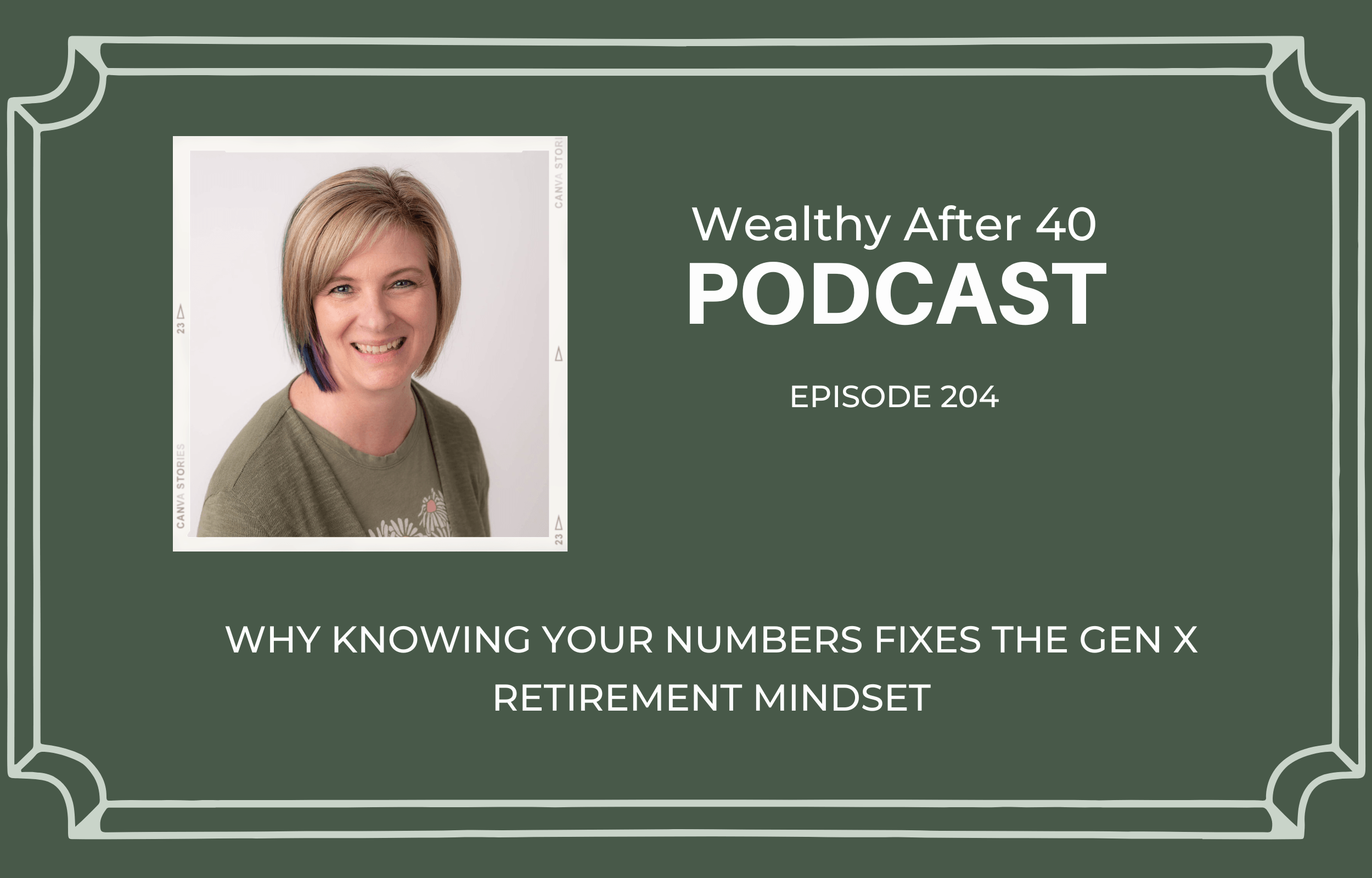
Listen to the Wealthy After 40 Podcast on: Apple Podcasts | Spotify | Your Player of Choice
Click HERE for an Unedited Transcription of the Podcast Episode
When you think about retirement, you get excited for a short moment because what starts coming up are, "Oh, what about getting my kids to college? What about that home remodel? What about all of the debt I need to pay off?" Your mind immediately takes you into a downward spiral and you think, "I just can't do all of that," so you don't do anything. The problem here isn't that you can't do it all, it's that you're first believing it has to be an all or nothing, this is a belief that you're saying, "If I can't do it all, I can't do anything." And you make those claims without any facts. I see this with my clients as I begin to work with them. They're very intelligent, very capable, and as they begin the process, it doesn't go exactly how we described it should, and they're like, "I can't do it." That's an all or nothing. They made progress, but they didn't reach the true result that they wanted. And guess what? It-- that is going to take time. Number one, it's going to take time to reset that mindset, and number two, believe that small steps will get you further ahead than just sitting in this, "I can't do all of that." So making... Again, making that claim without any facts when what you need is a system that is going to help you see how those goals can be a possibility, a system that is going to guide you to working through each of those goals one at a time. Again, we don't let ourselves step back into that all or nothing mindset. And if you feel stuck in that mindset and you want to break free from that, I would love to have you book a money clarity call so that we can figure out, number one, where's your money going, and why do you keep thinking, "I can't do it all"? And I'll help you find something that you can do to break free from that mindset. So going back to thinking about retirement and then your laundry list of goals, and again, I don't think your list is too long. You might have three and then retirement is four. But what I want you to do first... Now, you may not be a journaler, but that's the term I'm going to use here because I think it's explains what I need you to do, so you don't have to technically write this down, but if you are a journaler, do. What I want you to do first is I want you to sit with each one of your goals individually, and I want you to think about why do you want to achieve that goal, what does it mean to you? Kind of the importance of it. Really sit with why do I want this goal, and then also how important is this goal to me, give it some shape. Give it some, details so you can start seeing it. As you begin to do that, you might wanna start pulling in some pieces, 'cause right now all your mind sees is a big goal with-- it's gonna have a big number, but you haven't defined that number, but before you dive into the number, you need to know why do you want this goal? How important is this goal for you to achieve? And then what does it start looking like? What are those pieces As you begin defining, defining the details and those pieces, you're gonna start seeing maybe where you can add some boundaries. And what I mean by boundaries is I can do it if it stays under this, or I can do it if it looks like this. And to give you an example, I want you to listen to episode fifty-eight. I did a guest episode with Steve Mullen, who shared how he thought about paying for his kids' college. That is going to give you-- y-you don't have to do it like Steve did, but it really opens up thinking about how that it sh- should look or how you should maybe approach it. And it doesn't mean that you should do exactly his or another one, but it just starts helping you see what boundaries and details can mean. All right. The next thing I want you to do is I want you to know your numbers. I really don't like that, but, it is true. You need to understand where you're at. Now, in this, there are two different views that I want you to start looking at. The first one is, if you don't have a budget, I really encourage you to make one because you need to know, what are my expenses? Where is everything going? What does my debt look like? And what is my savings appease me, what do I potentially have for saving? I talk about how you can calculate that with a very simple bills spending and a saving bucket, and then using that savings to create what you want. It's exactly what I do with my clients, and really getting detailed in, where's my money going? What does it look like? The next set of numbers that you need to look at is progress to retirement, are you on track? How does it look? Do you really need to find more retirement savings? Would this expense compete with that, what does all of that look like, it's a whole encompassing... You have to look at the whole encompassing to be able to make the best decision for you For example, my client, we began working. We did a quick strategy session the very beginning, and, it helped her find out where her biggest hiccup was, and she did know where it was. It was in reti-- or debt. And so we were diving into that, building her a system that stopped the debt from being created. And now, as we've worked through that, that's beginning to evolve, still in the progress. We went to actually calculate her retirement progress using my Retirement Ready dashboard, sh-- I said, "Update everything that you have on there so that we can see, if you need to tackle your s-retirement savings more heavily as you're coming up on these payoff dates with your debt and shifting instead of continuing to snowball. What does that look like?" She says I remember when I first filled it out, I didn't have all of my information. I remembered some accounts." This is a very common when I work with clients. As they start doing more with their money and start doing more with their accounts, they remember what they have somewhere, and it becomes a very solid, complete piece. So as she updated that, she sent me a message. She says, "I've got that done. Let me know what you think." She's ninety-five percent there. She has twenty thousand dollars left through her projection and her retirement estimated expenses. Twenty thousand is nothing on the scheme of that she needs, two million. And so now she can actually look at, "How can I work with this money better?" She has some short-term goals as well. She wants to buy another house. She obviously still needs to pay off her debt, but there's, She's like, "We want to buy a camper or a motor home so we can travel around and see our kids." They're getting older. They're moving on, all of these plans, very similar plans to you, because we are reaching that empty nest, because we are getting ready for retirement, all of these things are happening. But really, for her, the power has come where she's actually got into her numbers. She's actually pulling everything completely into it and showing her that retirement savings isn't something that she needs to double down on, so she has freedom in that money because she knows she's still got, many years to work that she wants, and she will get raises, which means employer will add some more to that as well. That little gap is going to close off, plus whatever the market does, it's a whole piece, and being able to look at that creates an empowerment that then you know the right decision to make, yes, you have all these goals, but how does it fit in? What does it look like? Now, I'm not saying that if you're in her situation, you can then achieve your goals, I remember starting my journey, and I was like, "Okay, 13 years, I wanna retire." And then I was like, "My daughter's eight. We're enjoying camping. We're riding..." They were riding motorcycles. I was riding a four-wheeler 'cause you know what? That was my speed. And we really, at that moment that I s- I staked the claim of retiring in 13 years, I said, I would really like to buy a piece of recreational property." It was a dream for a while, and when I was able to do that, wow. But it was because I had done what I asked you to do at the very beginning. Why do you want these, how important is it? The pieces of having our camp trailer, the pieces of having our motorcycles and our four-wheeler, those were important, and those were small. Those were easy, but having that piece of recreational property so we didn't have to compete for a space and camping spots, being with, neighborhoods in the mountains as opposed to just peace. And so really looking at how that became a possibility was because of my system, because I knew I was doing one long term and one short term, and I went all in on both, now, you don't have to simplify to that, one and one. There are several things you want to do. Think about the priority. Think about what you want. Think about it in pieces, just like I did. We were able to do half of our dream, should I say? And being able to get through that. So What I want you to remember from this episode is I want you to lose the all or nothing mindset, it's not serving you well. It's causing you to feel overwhe-whelmed quicker, be frustrated more often. And I want you to dive into your numbers until you reach all of your goals. Okay? Those numbers are gonna guide you to your goals. You should have goals. You should be ach-achieving them, and that is how you do it. So if you want some help in getting started, book a money clarity call. We'll dive into where's your money go-going, and what can you do to reach those goals. I'll also share what it looks like to work inside the Retirement Ready Coaching and the process that, just like my client, we could find and resolve and really help you get rid of those things that I'm never going to be able to do 'em and achieve those things that you want. Most of the time, we are stuck because of something we are believing, and I hope this w- episode was helpful in freeing you from a belief that you were stuck in and recognizing that if you can just take small steps, you will be able to achieve retirement. Thank you for listening, and we'll see you next week. /p>
Financial progress takes time. Changing your habits takes time. Building new systems takes time. And sometimes, the first step isn't accomplishing the goal. It's learning to stop measuring your progress as if the only options are success or failure.
How to Balance Retirement Goals With Your Other Financial Goals
As you approach retirement, it's easy to see your goals as competing with each other.
Retirement.
Debt payoff.
College.
Home improvements.
Travel.
Helping your kids.
Building savings.
Living your life today.
It can feel like you have to choose one and sacrifice everything else. But that's not true.
Instead of asking: “How am I going to do all of this?” Try asking: “What matters most to me, and how can I make progress on these goals over time?” That's a very different question. It moves you out of panic and into planning.
You don't have to figure out how to accomplish everything tomorrow. You need to understand what you're trying to accomplish, why it matters, and how each goal fits into your overall financial picture.
Define Your Retirement Goals Before You Start Planning
Before you start crunching the numbers, spend some time with each goal individually.
You don't have to be a journaler to do this. You can simply sit down and think through each goal.
Ask yourself:
Why do I want this?
What does accomplishing this goal mean to me?
How important is this goal?
Is this something you absolutely want to make happen? Or is it something that would be nice if the circumstances allowed for it?
What does this goal actually look like?
You need to get specific. Instead of saying, “I want to help my kids with college,” what does that mean? Are you paying for four years? A portion of tuition? Housing? Books? A specific dollar amount?
Instead of saying, “I want to remodel my house,” what exactly do you want to change?
Instead of saying, “I want to travel,” what kind of travel are you envisioning?
The big goal can feel overwhelming because your brain attaches a big, undefined number to it. Breaking the goal into pieces helps you see what you're actually asking your money to do.
Listen to Episode 58: Should You Pay for Your Kid's College? College Planning and Financial Strategies with Steve Mullen to help you better understand how to make these goals fit in your life.
And once you have the details, you can start creating boundaries.
Maybe you decide: I'll do this as long as it stays under a certain amount.
Or: I'll help with this, but I won't take on debt to do it.
Or: We'll make this purchase once the current debt is paid off.
Boundaries turn vague goals into decisions.
Know Your Numbers Before You Make Retirement Decisions
This is the part nobody really wants to hear. You need to know your numbers. Not because your numbers are there to tell you what you can't do. They're there to show you what is actually possible.
If you don't have a budget, start there.
You need to understand:
What income is coming in
What your monthly expenses are
Where your money is going
What debt you have
What you're currently saving
What you potentially have available for additional savings or goals
A simple way to start is to think about your money in three buckets:
Bills. Spending. Saving.
When you know what's required for your bills and what you're choosing to spend, you can begin to see what is available to create the future you want.
But there's another set of numbers you need to understand. Your retirement numbers.
Your Retirement Plan Has to Be Part of the Conversation
You can't make good decisions about today's goals without understanding how they affect tomorrow.
Are you on track for retirement?
How much have you already saved?
What will your estimated retirement expenses look like?
How much more do you actually need to save?
Would paying off a particular debt create more flexibility later?
Would a large purchase significantly change your retirement timeline?
These are the questions that allow you to make intentional decisions instead of emotional ones.
Because sometimes the answer isn't, “You can't afford that.” Sometimes the answer is: “Yes, I can, but here's what needs to happen first.” That's a completely different conversation.
Use the retirement calculator I created to help you understand if you’re on track and what area of money to give focus to first.
How Knowing Your Numbers Can Help You Prepare for Retirement
I recently worked with a client who initially knew her biggest financial challenge was debt. We started by building a system designed to stop the cycle of creating new debt. As we worked through that, we also began looking at her retirement progress.
When she first completed her retirement information, she didn't have everything included. Some accounts were missing because she simply didn't remember them. That's common.
As you start paying more attention to your money, you often uncover accounts, savings, debts, and other pieces of your financial picture that you hadn't fully accounted for before.
So we updated everything and when we looked at her retirement projection, she was approximately 95% of the way there based on her projected needs. She had roughly a $20,000 gap. Now, $20,000 might sound like a lot in isolation. But when you're talking about a retirement need of around $2 million, it's a very different perspective.
Suddenly, she didn't have to panic and decide she needed to throw every available dollar into retirement savings. She had room to think about her other goals. She still wanted to pay off debt. She wanted to buy another house. She wanted a camper or motor home so she and her husband could travel to see their kids.
Those goals didn't disappear. But now she could look at them from a place of information rather than fear. That's what knowing your numbers can do. It can give you options.
How to Prioritize Financial Goals Before Retirement
You don't necessarily have to simplify your life down to one financial goal at a time. You just need to understand your priorities.
The time when I decided I wanted to retire in 13 years. But I also had a young daughter. We were camping, riding motorcycles, spending time together, and enjoying our life.
And I had another dream. I wanted to buy recreational property. At first glance, you could look at those goals and say, “You can't do both.”
But I didn't have to choose between living my life now and preparing for retirement. I created a system that allowed me to work toward both. Some goals were smaller and easier to accomplish. The recreational property was a much bigger goal.
But because I understood why those things mattered to me, I could prioritize them and figure out how they could fit together. And eventually, that recreational property became a reality.
Not because I magically had unlimited money. Because I had a system that helped me make decisions with the money I had.
Stop Worrying About Retirement and Start Making Progress
If you take one thing away from this episode, let it be this: You don't have to do it all right now. You don't even have to know exactly how you're going to accomplish everything today.
But you do need to stop allowing the belief that “I can't do it all” to become “I can't do anything.” Those are not the same thing. Small steps count. Progress counts. Adjusting your plan counts.
And most importantly, your numbers can help guide you.
Your financial goals shouldn't exist in separate boxes. Your debt, savings, spending, and retirement all need to be considered together so you can see the whole picture. Because retirement planning isn't about putting your entire life on hold until some future date.
It's about figuring out how to use your money intentionally so you can make progress toward the future while still living your life today. And you don't have to figure it all out alone.
Ready to Break Out of the “I Can't Do It All” Cycle?
If you're constantly wondering where your money is going and whether you'll ever be able to accomplish all the things you want, including retirement, let's take a closer look.
Book a Money Clarity Call, we'll look at what's happening with your money, identify what's keeping you stuck, and start finding a path forward.
You may not need to do more. You may need a better system for deciding what to do with what you already have. Because making retirement happen starts with knowing what's actually possible.
More about Wealthy After 40 with Dalene Higgins

Wealthy After 40 is the retirement planning and budgeting podcast for Gen X women and couples who are tired of wondering if they're doing enough for retirement and ready to know exactly what to do next. It's for people who are earning, saving, and trying to make smart money decisions, but still don't have a clear picture of whether the retirement they want is actually possible.
Hosted by Dalene Higgins, Retirement Strategist and Money Coach, this show gives you a simpler way to think about retirement. Instead of generic calculators, complicated financial jargon, or being told to simply "save more," we'll look at your real numbers, your real life, and the decisions that can make the biggest difference.
I’ll answer questions like:
How much do I really need to retire?
Am I actually on track for retirement?
How do I catch up if I feel behind?
Is it too late to save for retirement at 50?
Should I pay off debt or save for retirement?
How much should I have saved by 50?
When can I realistically retire?
How much should I be saving for retirement?
How do I create a retirement plan that actually fits my life?
What is the 4% rule, and does it really apply to me?
What should I do if I want to retire sooner?
This podcast is about more than saving for retirement. It's about understanding what’s holding you back and how to make intentional decisions with your money today without putting your entire life on hold for tomorrow.
Wealthy After 40 will help you move from worrying about whether retirement is possible to knowing what you need to do to make it happen, while still enjoying the life you're living right now.
